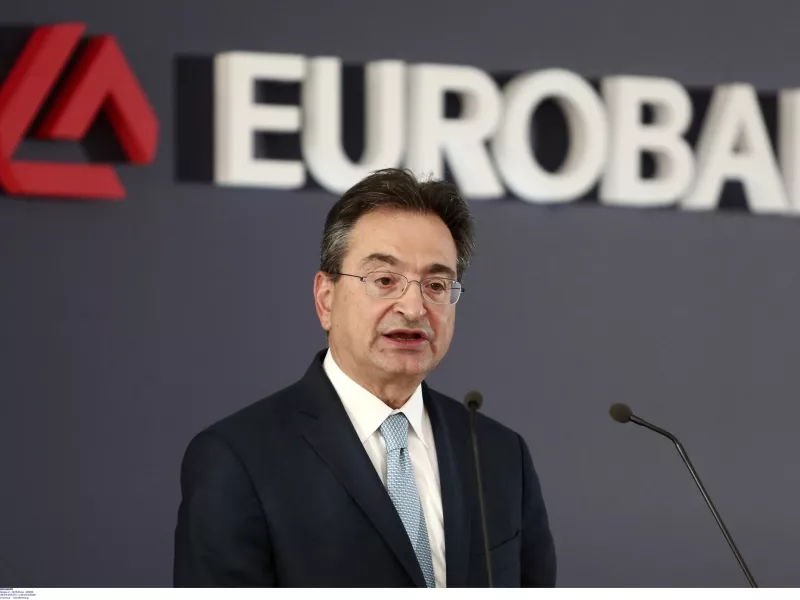
Eurobank reported a strong set of first-half 2026 results on Thursday, with adjusted net profit climbing to €776 million and management raising its full-year targets on the back of faster-than-expected organic growth across Greece, Cyprus and Bulgaria.
The Greek lender's adjusted net profit rose 9.2% year-on-year, while reported net profit attributable to shareholders reached €738 million, up 6.8%. Earnings per share came in at €0.20, against €0.19 a year earlier, and the bank's return on tangible book value held at 16.6%.
Loans and deposits expand across all three markets
Organic loan growth reached €2.7 billion in the first half, a 10.5% year-on-year increase, split roughly evenly between Greece (€1.4 billion) and the bank's non-Greek operations (€1.3 billion). Total gross loans stood at €58.1 billion at the end of June, with business loans accounting for €36.3 billion, mortgages €13.0 billion and consumer loans €5.1 billion.
Customer deposits rose by €2.9 billion in the first half -excluding a short-term corporate deposit of €0.8 billion that matured on 1 July- to reach €86.4 billion, a 9.6% annual increase. Managed funds, which the bank has flagged as a strategic priority, jumped 29.2% year-on-year to €11.0 billion, while private banking client assets and liabilities grew 10.2% to €14.9 billion.
Total assets stood at €112.9 billion at the end of June, made up of €66.0 billion in Greece, €29.3 billion in Cyprus and €14.6 billion in Bulgaria.
Income growth outpaces costs
Net interest income rose 6.1% year-on-year to €1,348 million, even as the net interest margin narrowed by 5 basis points to 2.46%, reflecting lower ECB rates (the average ECB deposit facility rate fell to 202 basis points in the first half of 2026, from 252 basis points a year earlier).
Net fee and commission income grew more strongly, up 13.5% to €414 million, driven by lending, wealth management and insurance business. Total operating income increased 9.0% to €1,810 million, while operating expenses rose 7.8% to €662 million, leaving the cost-to-income ratio at 36.6%.
Core operating profit before tax rose 10.0% to €952 million, as loan loss provisions fell 4.9% to €148 million, equivalent to 53 basis points of average net loans.
Asset quality and capital continue to strengthen
The non-performing exposures (NPE) ratio improved to 2.5% from 2.8% a year earlier, while the provisions-to-NPE coverage ratio stood at 82.4%. Capital ratios remained comfortably above regulatory requirements, with the Common Equity Tier 1 (CET1) ratio at 15.4% and the total capital adequacy ratio at 20.3%, both on a pro forma basis for a planned synthetic securitisation. Tangible book value per share rose 8.0% year-on-year to €2.57.
The non-Greek operations (Cyprus and Bulgaria) contributed 46.5% of group adjusted net profit, or €361 million, though the figure was down 3.3% year-on-year as profit in Cyprus declined 7.7% to €231 million. Bulgaria's contribution grew 7.8% to €119 million.
CEO points to resilient growth despite geopolitical risk
CEO Fokion Karavias said the bank's core markets had remained on a solid growth path despite ongoing tensions in the Middle East, with Greece's economy supported by investment activity, tourism and continued credit expansion. He noted that prudent fiscal management in Greece was helping to cushion the impact of inflation on more vulnerable households, while economic sentiment in Cyprus and Bulgaria also remained robust.
Karavias highlighted that the loan book had grown 10% annually in the first half and by €1.6 billion in the second quarter alone, while managed funds increased by €2.5 billion year-on-year.
On the back of the momentum, Eurobank said it now expects full-year 2026 EPS growth "well above 10%," translating into a return on tangible book value close to 17%, up from previous guidance of 16%.
Read the News today and stay informed about the latest news.
Follow Skai.gr on Google News and be the first to know all the news.